Patanjali Civil Services Academy (PCSA): Courses, Features, Teaching Approach and Everything UPSC Aspirants Should Know
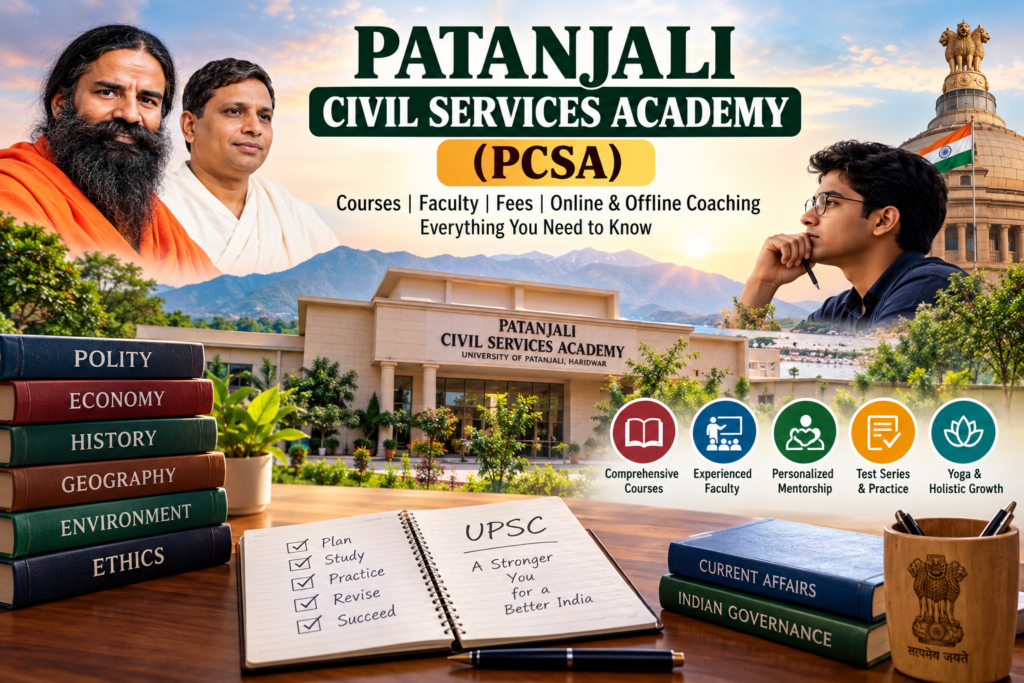
Preparing for the UPSC Civil Services Examination is a demanding journey that requires conceptual clarity, consistent practice, discipline and the ability to analyse complex issues. With numerous coaching institutes available across India, aspirants increasingly look for institutions that offer more than classroom teaching.
Patanjali Civil Services Academy (PCSA) is an institute focused on civil services preparation that combines structured academic learning with personal mentorship, ethical development, Indian knowledge traditions and a focus on students’ overall well-being. Located at the University of Patanjali in Haridwar, Uttarakhand, the academy aims to prepare aspirants for competitive examinations while encouraging discipline, leadership and a sense of public service.
But what exactly is PCSA? Which courses does it offer? Can students prepare online? What makes its approach different? Here is a detailed guide to help aspirants understand the academy and explore whether it suits their preparation needs.
What Is Patanjali Civil Services Academy (PCSA)?
Patanjali Civil Services Academy, commonly known as PCSA, is a civil services coaching institution associated with the broader Patanjali educational and wellness ecosystem.
Its primary focus is helping students prepare for India’s civil services examinations, particularly the Union Public Service Commission (UPSC) Civil Services Examination. This examination is conducted to recruit candidates for services such as the Indian Administrative Service (IAS), Indian Police Service (IPS) and Indian Foreign Service (IFS), along with other central services.
PCSA promotes an approach that combines conventional academic preparation with personal development. Its stated educational philosophy emphasises intellectual ability, ethical understanding, mental resilience and an appreciation of India’s cultural and knowledge traditions.
The academy’s approach is built around a central idea: civil services preparation should not only help candidates understand the examination syllabus but also encourage them to develop the qualities required for responsible public administration.
Official website: https://www.pcsa.in/
Where Is Patanjali Civil Services Academy Located?
PCSA is located at:
First Floor, Administrative Block, University of Patanjali, Haridwar – 249405, Uttarakhand, India.
Haridwar is known for its spiritual heritage and educational institutions. The academy’s location within the University of Patanjali provides the setting for its emphasis on a disciplined learning environment and holistic development.
Students considering offline or residential study should confirm the current campus arrangements, accommodation availability, food facilities, course schedules and applicable charges directly with the academy before enrolling.
Who Is Associated With Patanjali Civil Services Academy?
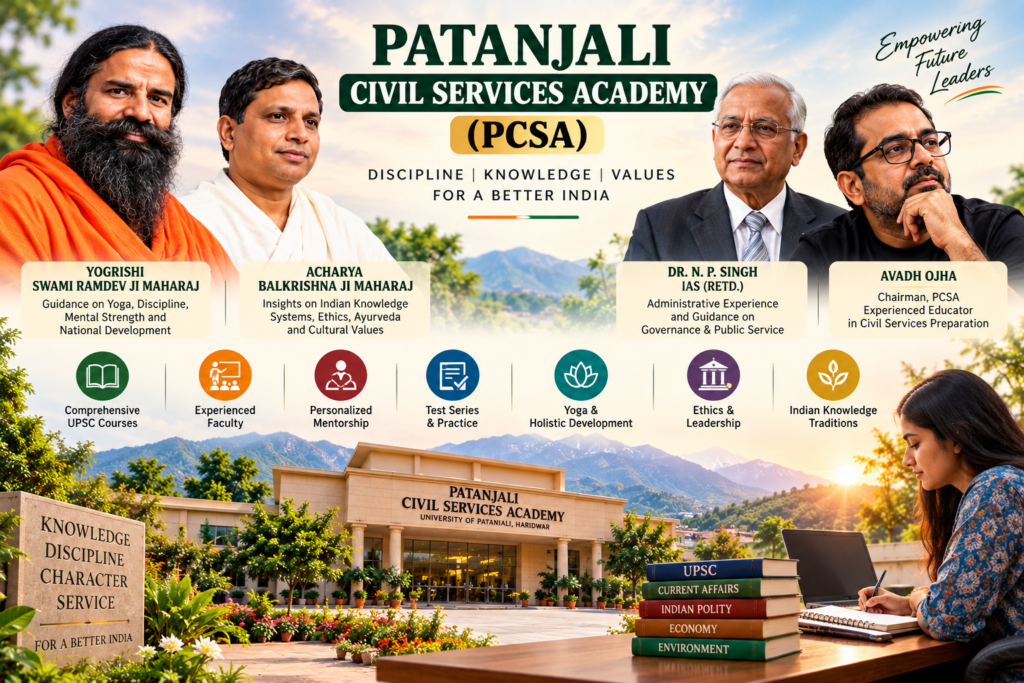
PCSA’s official website highlights several prominent figures associated with its vision, guidance and educational approach.
1. Yogrishi Swami Ramdev Ji Maharaj
Swami Ramdev Ji is widely known for his work in yoga and wellness and for founding Patanjali Yogpeeth. PCSA describes his engagement with students in areas such as yoga, mental focus, stress management, leadership, national development and India’s cultural heritage.
These subjects are relevant to aspirants who want to develop a disciplined routine and manage the psychological demands of competitive examination preparation.
2. Acharya Balkrishna Ji Maharaj
Acharya Balkrishna Ji is associated with Patanjali Ayurved and is known for his work on Ayurveda, Sanskrit, traditional knowledge and Indian literature.
The academy highlights his perspective on Indian knowledge systems, ethical leadership and traditional approaches to management. Such themes can provide additional context for understanding Indian society, culture and ethical questions.
3. Dr. N. P. Singh, IAS (Retd.)
The academy’s website identifies Dr. N. P. Singh, a retired IAS officer, as a guiding figure. His association brings an administrative and governance-oriented perspective to the academy’s broader vision.
4. Avadh Ojha
Avadh Ojha is listed on the academy’s official website as its chairman. He is known for his civil services teaching and history-related educational content.
The academy presents its approach as a combination of examination-oriented instruction, conceptual understanding and personal transformation.
Note: The roles described above reflect the academy’s published information. Aspirants should check the official website for the latest faculty roster, teaching schedules and details of individual faculty participation in particular batches.
What Courses Does Patanjali Civil Services Academy Offer?
PCSA lists several programmes designed for different stages of civil services preparation. Their durations and structures differ, so students should choose according to their preparation level and available time.
1. Tapovan Offline Foundation Course — Two Years
The Tapovan Offline Foundation Course is designed for students who want a structured, classroom-based preparation programme.
A two-year foundation programme can be particularly useful for beginners who need to develop their understanding of subjects before progressing to advanced examination practice.
The programme is intended to provide a structured preparation journey covering foundational concepts, advanced learning, revision and testing.
Students considering this course should confirm the current batch timetable, classroom teaching hours, faculty allocation, residential arrangements and fee structure with PCSA.
2. Tapovan Online Foundation Course — Two Years
The Tapovan Online Foundation Course is designed for aspirants who want to prepare without relocating to Haridwar.
According to the academy’s published course description, the programme is organised into three phases:
- Foundation building — six months: Building conceptual understanding through NCERT textbooks and further reading.
- Advanced learning — one year: Developing subject knowledge and analytical skills for the examination.
- Revision and tests — six months: Revisiting important concepts and practising through structured assessments.
The published programme also describes live interactive classes, a test series and personal mentorship as components of the course.
An online programme may be suitable for students balancing preparation with family responsibilities, college or other commitments. Before enrolling, candidates should verify class timings, access to recordings, doubt-resolution arrangements and the precise scope of mentorship.
3. Aadhaarshila Course — Six Months
The Aadhaarshila Course is listed as a six-month programme.
Its name suggests a foundational orientation, but aspirants should consult the latest official course description to understand its exact syllabus, intended audience, teaching format and whether it is suitable for complete beginners or candidates with prior preparation.
Students should not assume that every foundation programme covers the same material or provides the same level of examination support.
4. Disha-Bodh Mentorship Programme — One Year
PCSA lists the Disha-Bodh Mentorship Programme with a duration of one year.
Mentorship can play an important role in civil services preparation by helping candidates organise their study schedules, assess their progress, identify weaknesses and make informed decisions about revision and practice.
Before joining, students should ask whether mentorship is individual or group-based, how frequently sessions are held, whether written answers are reviewed and what level of personalised feedback is included.
5. Osmosis Test Series — One Year
The Osmosis Test Series is listed as a one-year programme.
Regular testing helps aspirants evaluate their knowledge, improve time management, identify recurring mistakes and become familiar with examination conditions.
For UPSC candidates, a useful test programme should ideally provide more than a score. Detailed explanations, performance analysis, discussions of incorrect answers and guidance on improving answer quality can make practice more effective.
Candidates should confirm the current test schedule, number of tests, subjects covered and availability of evaluation or feedback.
What Subjects Can Students Study at PCSA?
The academy’s published online foundation course covers a range of General Studies subjects relevant to UPSC preparation.
These include:
- Indian Polity
- Indian Economy
- Indian History
- World History
- Geography
- Environment
- Disaster Management
- Ethics
- Science and Technology
- Internal Security
- International Relations
- Social Issues and Social Justice
- Governance
- Current Affairs
These subjects are important components of UPSC preparation, particularly for the General Studies papers in the Preliminary and Main examinations.
However, the full UPSC preparation process also requires attention to the Civil Services Aptitude Test (CSAT), essay writing, optional subjects for the Main examination, answer-writing practice and the personality test. Aspirants should confirm how each of these areas is addressed in the particular course they intend to join.
How Is the Teaching Approach at PCSA Different?
PCSA presents itself as an institution that combines academic preparation with broader personal development.
Conceptual Learning
Understanding concepts is essential for the UPSC examination because candidates are expected to interpret information, connect topics and apply knowledge rather than rely exclusively on memorisation.
The foundation-course structure described by the academy begins with basic learning resources and progresses towards more advanced subject preparation.
Current Affairs and Examination Practice
Current affairs help aspirants connect static subjects with contemporary developments in governance, the economy, international relations, the environment and society.
PCSA’s website publishes current-affairs explainers and examination-oriented practice questions. These can serve as supplementary learning resources for candidates building a daily study routine.
Revision and Retention
The volume of information required for civil services preparation makes revision essential.
A structured revision plan, regular testing, short notes and repeated recall can help candidates identify what they know well and what needs further attention.
Answer Writing and Analytical Skills
The UPSC Main examination tests a candidate’s ability to present arguments clearly, organise information and respond directly to questions.
Aspirants should prioritise courses and practice routines that include answer writing, constructive evaluation and opportunities to improve their analytical approach.
Ethics, Leadership and Public Service
PCSA highlights ethical development, leadership and a commitment to public service as important aspects of its educational philosophy.
These themes connect naturally with the demands of public administration and the Ethics, Integrity and Aptitude paper in the UPSC Main examination.
Beyond Coaching: Yoga, Wellness and Holistic Development
One of the distinguishing themes in PCSA’s presentation is its emphasis on holistic development.
The academy describes a learning environment that incorporates three elements:
Sattvic nourishment: An emphasis on mindful food choices and a disciplined daily routine.
Holistic health: Attention to overall well-being and the importance of maintaining healthy habits during an intensive study period.
Sattvic atmosphere: A focus on creating a calm, disciplined environment that supports learning.
The academy also highlights yoga and mental-focus sessions associated with Swami Ramdev Ji.
Civil services preparation can extend over a long period, and students may face pressure, uncertainty and fatigue. Regular physical activity, adequate sleep, balanced meals, breaks and a realistic study timetable can support general well-being.
These practices are best viewed as complements to a strong academic strategy, not substitutes for studying the syllabus, solving questions or receiving appropriate academic feedback.
Online vs Offline Preparation: Which PCSA Course Should You Choose?
The choice between online and offline preparation depends on an aspirant’s circumstances, learning preferences and need for structure.
| Factor | Online preparation | Offline preparation |
|---|---|---|
| Location | Study from your current city | Attend classes at the designated centre |
| Flexibility | May offer greater flexibility, depending on the timetable | Usually follows a fixed classroom schedule |
| Interaction | Through online classes and available support channels | Direct classroom interaction |
| Relocation | Generally not required | May be necessary for outstation students |
| Study environment | Requires self-discipline at home | Provides a dedicated classroom setting |
| Additional expenses | Internet and study equipment | Travel, accommodation and food may add to costs |
Neither format automatically guarantees better results. The more suitable choice is the one that helps a student maintain consistency, understand difficult subjects, practise regularly and receive useful feedback.
Who Should Consider Patanjali Civil Services Academy?
PCSA may be worth exploring for several types of aspirants.
Beginners: Students starting UPSC preparation who need a structured learning path.
College students: Candidates who want to begin preparation well before graduation, subject to the applicable examination eligibility rules.
Working aspirants: Students considering online preparation alongside professional responsibilities.
Candidates seeking mentorship: Aspirants who want help organising their preparation and maintaining consistency.
Students interested in holistic learning: Candidates who appreciate an educational environment that includes discussions of yoga, ethics, leadership and Indian knowledge traditions.
The right decision depends on the student’s budget, learning needs, preparation level and the quality of the specific course being offered. It is advisable to attend a demonstration class and speak to current or former students before making a financial commitment.
How to Apply for Admission to PCSA
Students interested in joining the academy can begin by visiting its official website: https://www.pcsa.in/
A sensible admission process includes the following steps:
- Explore the courses: Compare the Tapovan Offline Foundation Course, Tapovan Online Foundation Course, Aadhaarshila Course, Disha-Bodh Mentorship Programme and Osmosis Test Series.
- Check eligibility: Confirm any educational requirements, age-related considerations and admission-test requirements applicable to the selected programme.
- Review the syllabus: Request a detailed subject-wise course outline and teaching schedule.
- Attend a demo class if available: Assess teaching clarity, interaction and the relevance of the material to your preparation needs.
- Confirm fees and facilities: Obtain written details of tuition fees, study materials, accommodation, food, taxes, scholarships, refund terms and other applicable charges.
- Complete the official admission process: Follow the instructions provided directly by the academy.
Admission dates, batch commencement, course fees and eligibility requirements can change. They should be verified directly rather than relying on older advertisements or third-party listings.
Contact Details of Patanjali Civil Services Academy
For course information and admissions, the academy’s website lists the following contact details:
Institution: Patanjali Civil Services Academy (PCSA)
Address: First Floor, Administrative Block, University of Patanjali, Haridwar – 249405, Uttarakhand, India
Phone: +91 8679601119 / +91 8679401119
Email: info@pcsa.in
Website: https://www.pcsa.in/
Contact details and active admission channels should be reconfirmed on the official website before making payments or travelling to the campus.
What Should Aspirants Check Before Enrolling?
Selecting a civil services coaching institute is an important academic and financial decision. Before enrolling at PCSA or any other academy, candidates should evaluate:
- The qualifications and experience of the faculty teaching their batch.
- The number of teaching hours and the completeness of the syllabus.
- The quality of study material and its alignment with the latest examination requirements.
- The frequency of mock tests and the quality of answer evaluation.
- The availability of doubt resolution and personalised mentorship.
- The actual cost of tuition, accommodation, food and additional services.
- The refund policy and terms and conditions.
- The institute’s verifiable results and the specific course or batch associated with those results.
Students should distinguish between an institute’s educational philosophy, its advertised offerings and independently verifiable examination outcomes. Enrolling in a coaching programme can provide structure and support, but selection ultimately depends on several factors, including individual preparation, examination performance and available opportunities.
Frequently Asked Questions About PCSA
What does PCSA stand for?
PCSA stands for Patanjali Civil Services Academy.
Where is Patanjali Civil Services Academy located?
The academy is located at the University of Patanjali in Haridwar, Uttarakhand, India.
Does PCSA offer online UPSC coaching?
Yes. Its official website lists a two-year Tapovan Online Foundation Course, with a published structure covering foundation building, advanced learning, revision, tests and mentorship.
What is the duration of the Tapovan Foundation Course?
The academy lists both offline and online Tapovan Foundation Courses with a duration of two years.
Does PCSA offer a test series?
Yes. The academy lists the Osmosis Test Series as a one-year programme. Candidates should verify the current schedule and evaluation features before enrolling.
Who is the chairman of Patanjali Civil Services Academy?
PCSA’s official website identifies Avadh Ojha as its chairman.
What is the fee for PCSA courses?
Fees should be obtained directly from the academy because the applicable amount can vary by course, batch and admission terms.
Does joining PCSA guarantee UPSC selection?
No coaching institute can guarantee selection in the UPSC Civil Services Examination. Coaching can provide structure, learning resources and guidance, but the outcome depends on individual preparation and examination performance.
Final Verdict: Is Patanjali Civil Services Academy Worth Exploring?
Patanjali Civil Services Academy presents an approach to civil services preparation that brings together structured courses, current-affairs resources, test practice, mentorship and an emphasis on personal development.
Its two-year Tapovan Foundation programmes may be worth examining for aspirants seeking a longer preparation pathway, while its shorter course and mentorship options may appeal to candidates with more specific requirements.
The academy’s combination of academic learning, yoga-related wellness and Indian knowledge traditions gives it a distinctive stated educational philosophy. Nevertheless, prospective students should compare the actual teaching quality, fees, mentorship arrangements, test evaluation and independently verifiable outcomes before deciding.
Ultimately, the best coaching institute is not necessarily the one with the most prominent name. It is the one that offers the right combination of teaching, practice, feedback and support for a student’s individual needs.
For aspirants considering PCSA, the next step is straightforward: review the official course details, ask specific questions about the programme and make an informed decision before enrolling.
For the latest course information and admission updates, visit the official Patanjali Civil Services Academy website at https://www.pcsa.in/.