
Anthropic IPO 2026: Inside the $81 Billion Stock Market Debut – Share Price, Valuation and What’s Next ?

The artificial intelligence industry has witnessed a historic moment. Anthropic, the company behind the popular Claude AI chatbot, has officially entered the stock market with one of the largest initial public offerings (IPOs) in financial history.
On November 19, 2026, Anthropic made its Nasdaq debut under the ticker symbol ANT, raising approximately $81.3 billion through its public offering. The company priced its shares at $83 each, attracting extraordinary investor demand and pushing its valuation to unprecedented levels.
The IPO has not only created excitement among Wall Street investors but has also brought enormous attention to Anthropic’s founders, early investors and employees, many of whom hold company stock.
With artificial intelligence becoming one of the biggest investment themes worldwide, Anthropic’s stock market debut raises an important question: Is this the beginning of a new era for AI investments, or are investors paying too much for future growth?
Let’s examine everything investors need to know about the Anthropic IPO in 2026.
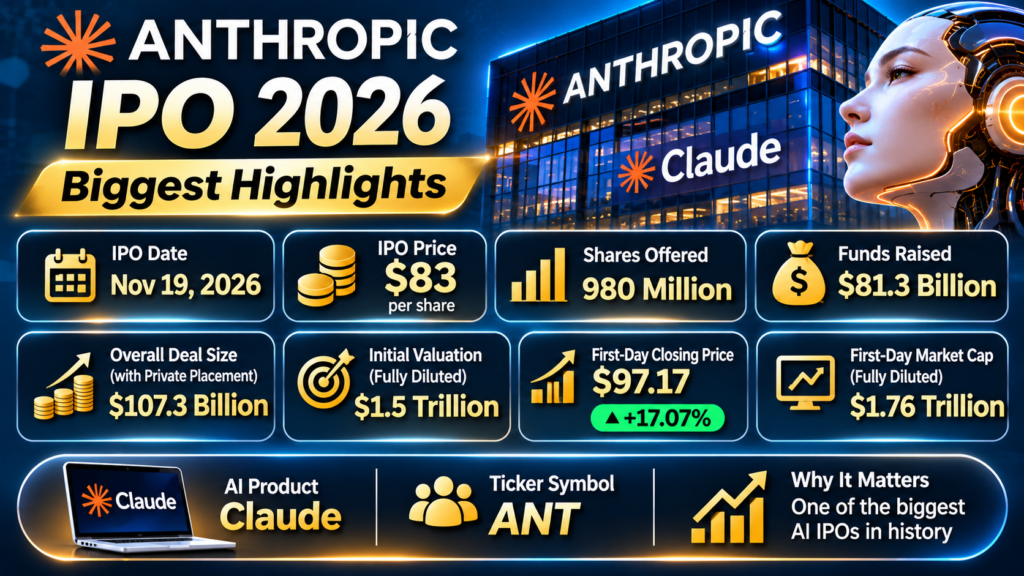
1. Anthropic IPO 2026: The Biggest Highlights
Anthropic’s IPO has become a landmark event in the global technology industry.
Here are the important details:
| IPO Details | Information |
|---|---|
| Company | Anthropic, PBC |
| AI Product | Claude |
| Stock Exchange | Nasdaq |
| Ticker Symbol | ANT |
| IPO Date | November 19, 2026 |
| IPO Price | $83 per share |
| Shares Offered | 980 million |
| IPO Proceeds | Approximately $81.3 billion |
| Initial Fully Diluted Valuation | Approximately $1.5 trillion |
| First-Day Closing Price | $97.17 |
| First-Day Gain | 17.07% |
The offering surpassed the previous record-setting IPO by SpaceX, making Anthropic’s debut one of the biggest events in global financial markets.
2. How Much Did Anthropic Raise Through Its IPO?
Anthropic raised approximately $81.3 billion by selling 980 million shares at $83 per share.
The company had initially indicated a price range of $70 to $78 per share. However, strong demand from institutional and retail investors allowed it to increase the final IPO price to $83.
The offering included newly issued shares as well as shares sold by existing shareholders.
There was also a separate $26 billion private placement at the IPO price. Including this transaction, the overall deal size reached approximately $107.3 billion.
This distinction matters: the $81.3 billion figure relates to the public offering, while the $107.3 billion figure includes the additional private placement.
The IPO was led by major financial institutions, including Goldman Sachs and Morgan Stanley.
3. Anthropic Share Price: How Did ANT Perform on Its First Trading Day?
Anthropic’s first day on Nasdaq attracted significant attention.
The IPO price was $83 per share, but demand pushed the stock considerably higher once trading began.
Here’s how the stock performed:
| Trading Metric | Share Price |
|---|---|
| IPO Price | $83 |
| Opening Price | $111.50 |
| Intraday High | $115.10 |
| First-Day Closing Price | $97.17 |
| Gain Against IPO Price | 17.07% |
The stock initially climbed more than 30% above its IPO price before giving up some of its gains.
At its first-day closing price of $97.17, Anthropic’s fully diluted market valuation stood at approximately $1.76 trillion.
The performance demonstrated strong investor appetite for major AI companies, although the decline from its intraday high also highlighted the volatility that can accompany newly listed technology stocks.
4. Anthropic Valuation: Is It Really a $1.5 Trillion Company?
One of the most discussed aspects of the IPO is Anthropic’s enormous valuation.
At the IPO price of $83, the company was valued at approximately:
- $1.1 trillion on a non-diluted basis.
- $1.5 trillion on a fully diluted basis.
After its first trading day, its fully diluted market valuation increased to approximately $1.76 trillion.
During the initial trading session, the valuation briefly crossed $2 trillion.
But what does a trillion-dollar valuation actually mean?
A company’s market capitalisation represents the market value of its outstanding shares. It does not mean the company has that amount of cash in its bank account.
Investors are essentially assigning a value to Anthropic based on its current business, growth opportunities, technology, customer base and expectations about future earnings.
For a company operating in the rapidly expanding AI industry, expectations can have a significant influence on its stock price.

5. Why Are Investors So Excited About Anthropic?
Anthropic is not simply another technology startup. It operates in one of the most competitive and commercially important areas of artificial intelligence.
Its Claude family of AI models has become popular among individuals, software developers and businesses.
Some of the major reasons behind investor interest include:
Claude AI: Anthropic’s flagship AI assistant competes in the rapidly growing market for conversational and productivity-focused AI tools.
Claude Code: Its AI-powered coding capabilities have attracted software developers and enterprise customers looking to automate programming tasks.
Enterprise Adoption: Businesses are increasingly integrating AI into customer service, software development, research, document processing and internal operations.
Recurring Revenue Opportunities: Subscription plans and enterprise contracts offer opportunities for recurring revenue.
AI Infrastructure: Anthropic’s partnerships with major cloud and technology companies help it access the computing resources required to develop advanced AI models.
The company has also benefited from the growing demand for AI tools that can perform complex business tasks rather than simply answer questions.
6. Anthropic Employees Could Become Millionaires After the IPO
One of the most fascinating stories surrounding the IPO is its potential impact on employees.
Like many successful technology startups, Anthropic has used equity-based compensation to attract and retain talented employees.
Employees who received stock options, restricted stock units or other equity incentives during the company’s earlier stages could see the value of their holdings increase significantly following the listing.
Imagine an employee who received shares when Anthropic was valued at a fraction of its current market capitalisation. If those shares appreciated substantially, the employee’s personal wealth could increase dramatically.
However, there is an important distinction between paper wealth and actual cash.
An employee’s stock value does not automatically become spendable money. The employee may face:
- Vesting requirements.
- Lock-up restrictions.
- Tax obligations.
- Trading restrictions.
- Market-price fluctuations.
The IPO has the potential to create substantial wealth for eligible employees, but individual outcomes depend on their shareholdings, exercise prices, vesting schedules and applicable tax rules.
This is another example of how equity compensation can turn employees into significant stakeholders in a successful technology business.
7. Anthropic’s Revenue Growth: Can It Justify the Valuation?
A major reason investors are paying attention to Anthropic is its rapid revenue growth.
According to its IPO disclosures and Reuters reporting, Anthropic’s annualised revenue run rate reached approximately $81 billion by October 31, 2026.
Its reported third-quarter revenue was approximately $16.96 billion, representing 47% growth compared with the previous quarter.
The company also reported a substantial increase in enterprise customers.
These numbers indicate that AI is becoming a significant commercial market.
However, revenue growth alone does not guarantee profitability.
Anthropic faces enormous expenses associated with:
- Training advanced AI models.
- Purchasing computing capacity.
- Operating data centres and infrastructure.
- Hiring highly specialised researchers and engineers.
- Developing and maintaining AI products.
Reuters reported that Anthropic had nearly $900 billion in computing commitments with infrastructure partners.
These commitments represent a major long-term financial consideration.
Investors will need to evaluate whether future revenue and operating cash flows can support such enormous infrastructure requirements.
8. Anthropic vs OpenAI: Who Could Dominate the AI Industry?
Anthropic’s public listing also puts the spotlight on its competition with OpenAI and other major AI companies.
Both companies are competing to build increasingly capable AI models and attract enterprise customers.
The competition extends across several areas:
| Competition Area | Anthropic | OpenAI |
|---|---|---|
| AI Assistant | Claude | ChatGPT |
| Coding Tools | Claude Code | Codex |
| Enterprise AI | Claude for business | ChatGPT Enterprise |
| AI Research | Advanced model development | Advanced model development |
| Market Strategy | Enterprise and AI products | Consumer and enterprise AI |
The AI industry is unlikely to have just one winner.
Companies may compete through different business models, specialised AI agents, enterprise partnerships, infrastructure investments and consumer applications.
For investors, the important question is which companies can convert technological advantages into sustainable revenue and profits.
9. What Are the Biggest Risks of Investing in Anthropic Stock?
Despite its extraordinary IPO, Anthropic is not a risk-free investment.
Investors should carefully consider several challenges before purchasing ANT shares.
1. Extremely High Valuation
A fully diluted valuation approaching $1.76 trillion leaves substantial expectations for future growth. If revenue or profitability disappoints, the share price could decline.
2. High Infrastructure Costs
Advanced AI models require enormous computing resources. Anthropic’s significant infrastructure commitments could put pressure on its future financial performance.
3. Competition
OpenAI, Google, Microsoft, Meta and other technology companies are investing heavily in artificial intelligence.
4. Profitability
Rapid revenue growth is encouraging, but investors must also examine operating margins, cash flow and long-term earnings potential.
5. AI Regulation and Safety
Governments worldwide are developing policies around AI safety, privacy, copyright and responsible deployment. Regulatory changes could affect how AI companies operate.
6. Stock Market Volatility
Newly listed technology companies can experience significant price movements, particularly when their valuations depend heavily on expectations of future growth.
10. What’s Next for Anthropic After Its Historic IPO?
The IPO is only the beginning of Anthropic’s journey as a public company.
Its future performance will depend on several important developments.
Quarterly Financial Results
Investors will closely monitor revenue growth, operating expenses, profitability and cash flow.
New Claude Models
Anthropic will need to continue improving its AI models to remain competitive.
Enterprise Expansion
Winning more corporate customers and expanding existing contracts could become a major source of future growth.
Infrastructure Investments
The company will need to manage its computing commitments carefully while ensuring that infrastructure spending generates commercial returns.
Competition With Other AI Companies
The ability to maintain technological leadership and customer loyalty will be critical.
Its public-market performance will also provide an important indicator of investor confidence in the broader AI industry.
11. Should Investors Buy Anthropic Stock in 2026?
Anthropic’s IPO has created an exciting opportunity for investors interested in artificial intelligence.
However, buying a newly listed stock simply because its IPO has attracted enormous attention can be risky.
Investors should evaluate:
- Current market capitalisation.
- Revenue growth and operating margins.
- Future earnings potential.
- Infrastructure spending.
- Competitive advantages.
- Share-price volatility.
- The company’s quarterly financial disclosures.
The IPO price of $83 and first-day closing price of $97.17 provide useful reference points, but neither guarantees future returns.
Investors should also consider their investment horizon, risk tolerance and portfolio diversification before making a decision.
For Indian investors, exposure to a US-listed stock may also involve currency movements, brokerage charges, applicable taxes and overseas investment regulations.
Anthropic’s public listing is an important development for the global AI investment landscape, but investors should distinguish between the long-term potential of artificial intelligence and the price they are paying for an individual company’s shares.
Final Thoughts: Anthropic’s IPO Marks a New Chapter for AI
Anthropic’s $81.3 billion IPO has established a remarkable milestone in technology and financial market history.
With a starting share price of $83, a first-day closing price of $97.17 and a fully diluted market valuation of approximately $1.76 trillion, the Claude developer has entered the public markets with enormous expectations.
The listing has also highlighted the financial opportunities created by employee equity ownership, the growing commercial importance of AI and the willingness of investors to fund companies developing advanced artificial intelligence.
But the real test begins now.
Anthropic must demonstrate that its technology, customer growth and revenue can translate into sustainable profitability.
For investors, the coming quarters will be more important than the excitement surrounding the IPO itself.
One thing is certain: Anthropic’s stock market debut has made artificial intelligence an even bigger part of the global investment conversation.