The AED 100 Crore Playbook: Institutional Yield and Residency Arbitrage in Dubai
An intelligent deployment of ₹100 Crores (approximately $12 million USD) in real estate requires moving past simple asset gathering. It demands a sophisticated playset that balances elite wealth preservation with aggressive, tax-shielded capital production.
In the global landscape, few regions offer the specific cross-section of regulatory stability, high-yielding liquidity, and structural perks found in the United Arab Emirates. This is an analytical breakdown of how to deploy a ₹100 Crore allocation into the Dubai market, optimizing for immediate yield, residency advantages, and long-term capital appreciation.
The Core Thesis: Yield & Residency
Deploying capital into Dubai at this scale transforms a real estate portfolio into a multi-layered financial strategy. Instead of tying up capital in low-yield or highly taxed domestic instruments, a ₹100 Crore allocation achieves three distinct objectives simultaneously.
The 10-Year Golden Visa: Investing a minimum of AED 2 million (~₹4.5 Crore) directly secures a 10-year residency visa. At the ₹100 Crore tier, this provides long-term optionality, global mobility, and a secure corporate/personal fallback position for your entire family and corporate dependents, completely decoupled from Indian tax residencies if structured correctly.
The Zero-Tax Shield:
Rental income and capital gains in Dubai are subject to 0% personal income tax. When paired with the direct peg between the UAE Dirham (AED) and the US Dollar ($1 USD = 3.6725 AED), your cash flow operates as a rock-solid, tax-free hedge against INR depreciation.
The Yield Arbitrage:
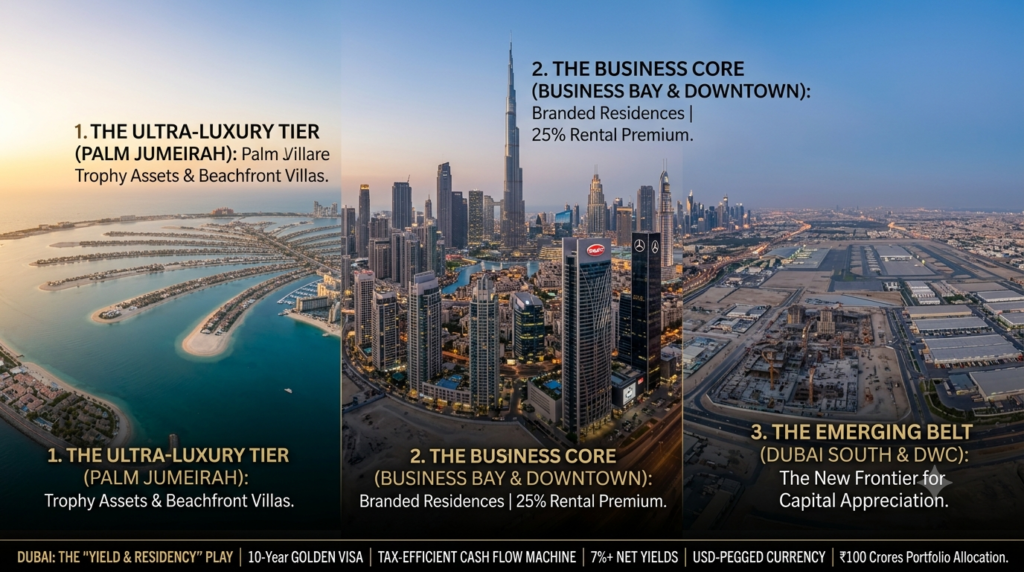
While prime residential yields in cities like Mumbai or London hover between 2% and 3.5%, Dubai’s core commercial and branded residential corridors consistently generate 7% to 9% net yields after property management expenses.Prime Allocation ZonesTo maximize risk-adjusted returns, the capital must be diversified across three distinct macroeconomic tiers within the emirate.
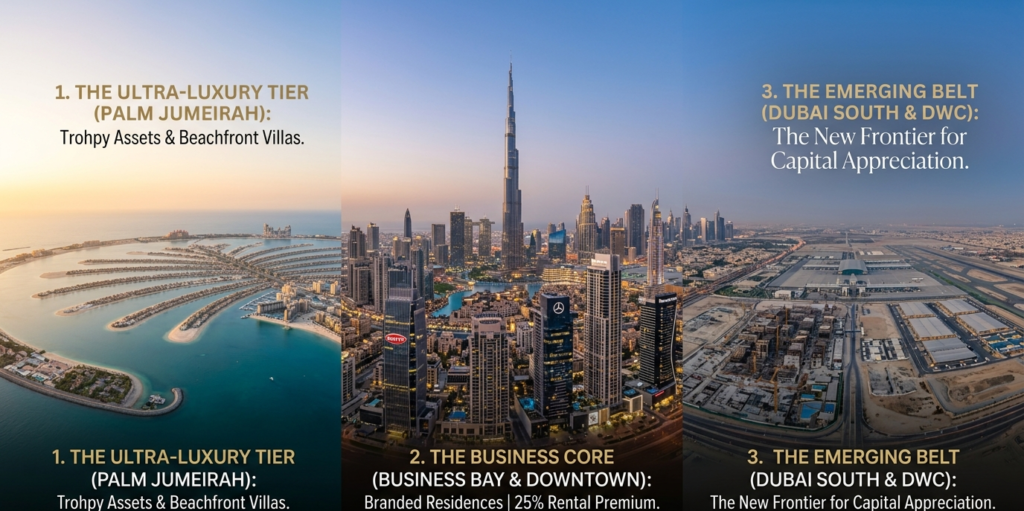
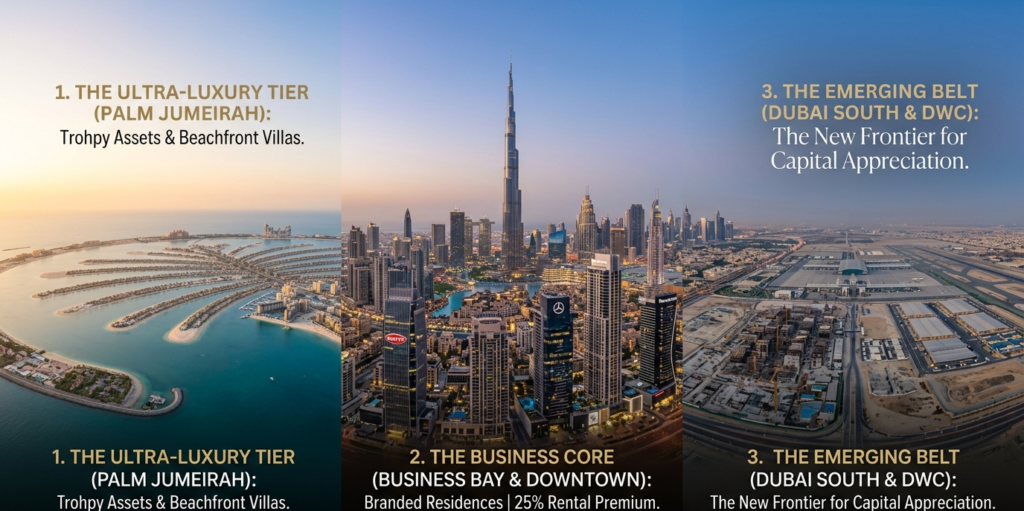
1. The Ultra-Luxury Tier (Palm Jumeirah & Emirates Hills)
The Landscape: This is the bedrock of wealth preservation. Prices in these hyper-exclusive enclaves average between AED 4,000 and AED 14,000 per sq. ft. Supply is fundamentally capped by geography; there is a finite amount of beachfront on the Palm and golf-course frontage in Emirates Hills.
The Play: Allocate capital here exclusively for “trophy asset” security. These properties act as the ultimate liquidity sink—highly insulated from standard market corrections because the buyer pool consists entirely of global ultra-high-net-worth individuals (UHNWIs) purchasing with cash rather than credit.
2. The Business Core (Business Bay & Downtown)
The Landscape: The dominant trend defining this sector is the rise of Standalone Branded Residences (e.g., Bugatti Residences, Mercedes-Benz Places). Buyers and corporate tenants are no longer just looking for square footage; they are paying for the operational standards, privacy, and prestige of elite global brands.
The Play: Branded units command an immediate 20% to 25% premium in rent compared to adjacent, unbranded luxury builds. They attract C-suite executives, multinational corporate leases, and high-earning expats who prioritize five-star concierge infrastructure and strict privacy protocols.
3. The Emerging Belt (Dubai South & Dubai Islands)
The Landscape: This is the pure capital appreciation play. Anchored by the monumental AED 128 billion expansion of Al Maktoum International Airport (DWC)—set to become the world’s largest airport—and massive infrastructure partnerships like the recently signed AED 62 billion Majid Al Futtaim master community, Dubai South is undergoing massive structural displacement.
The Play: Property valuations here currently sit up to 60% lower than the mature Business Core. Entering this zone provides a rare arbitrage opportunity, allowing investors to capture massive capital gains as the city’s economic and logistics gravity shifts decisively southward.
The Alpha Strategy: Tactical Deployment
With ₹100 Crores at your disposal, the optimal move is not to spread the capital thin, but to strike aggressively where yield and immediate liquidity intersect.
The recommended strategy is to allocate 40% of the total portfolio (₹40 Crores / ~AED 17.6 million) immediately into the Business Core. PORTFOLIO ALLOCATION TIER (₹100 CRORES TOTAL)
┌──────────────────────────────┐
│ Business Core (Yield) │ ──► Focus: Ready-to-Move / Business Bay
│ 40% (₹40 Crores) │ Target: 7%+ Net Yield (USD-Pegged)
├──────────────────────────────┤
│ Ultra-Luxury Tier (Value) │ ──► Focus: Trophy Assets / Palm Jumeirah
│ 40% (₹40 Crores) │ Target: Wealth Preservation & Liquidity
├──────────────────────────────┤
│ Emerging Belt (Growth) │ ──► Focus: Infrastructure / Dubai South
│ 20% (₹20 Crores) │ Target: Arbitrage & Capital Gains
└──────────────────────────────┘
Execution Directives
- Target Ready-to-Move (RTM) over Off-Plan: For this specific 40% yield engine, completely bypass the off-plan pipeline. Focus entirely on freshly handed-over or highly liquid, tenanted units in Business Bay. This eliminates construction risk and ensures your cash-flow machine begins distributing income on Day
- Lock in the 7%+ Net Yield Loop: By purchasing high-floor corporate apartments or premium branded residences in the commercial core, you secure institutional-grade tenants. A net yield of 7%+ after maintenance fees, paid in a USD-pegged currency, beats traditional western fixed-income or equity dividend yields on a risk-adjusted, post-tax basis.
- Establish the Local Corporate Structure: Route these acquisitions through a UAE Free Zone holding company or an offshore structure (like the ADGM or DIFC). This keeps the asset pool cleanly separated from personal liabilities, streamlines the Golden Visa processing for your designated corporate directors, and provides seamless estate planning advantages under UAE common-law frameworks.