How Doomsday Began: Every Marvel Clue That Led to Doctor Doom
From the Multiverse Saga and Loki’s timeline experiments to the Fantastic Four, the Avengers’ fractured world and the arrival of Doctor Doom — here’s how Marvel may have been building towards its biggest showdown yet.
For years, Marvel fans believed that Kang the Conqueror would be the ultimate villain of the Multiverse Saga. His variants, time-travelling experiments and ability to manipulate entire timelines seemed to be setting up an Avengers-level catastrophe.
But the Marvel Cinematic Universe took an unexpected turn.
The focus shifted towards a different character — one whose intelligence, ambition, technological genius and obsession with power make him one of the most dangerous figures in Marvel Comics: Victor von Doom, better known as Doctor Doom.
With Avengers: Doomsday on the horizon, an important question deserves attention: Did Marvel secretly leave clues about Doctor Doom throughout its previous movies and series, or did the story take a completely new direction?
To understand how Doomsday began, we need to revisit the events that changed the MCU, examine the connections between its major storylines and explore how the arrival of Doctor Doom could bring everything together.
1. The Multiverse Saga: The Beginning of the Chaos
The story of Doomsday cannot be understood without looking at the Multiverse Saga.
After the Infinity Saga ended with Avengers: Endgame, Marvel moved away from a single connected timeline and introduced a much bigger concept: multiple universes existing simultaneously.
The idea changed everything.
Previously, the Avengers were primarily protecting one universe from threats such as Thanos. Now, the possibilities became almost unlimited. Different versions of familiar heroes, alternate realities, branching timelines and entirely different worlds became part of the MCU.
Three major projects helped establish this foundation:
- Loki introduced the mechanics of branching timelines and the TVA.
- Spider-Man: No Way Home brought characters from different Spider-Man universes into one story.
- Doctor Strange in the Multiverse of Madness explored alternate realities and the consequences of travelling between them.
These stories established a dangerous possibility: the boundaries separating universes were becoming increasingly important — and increasingly vulnerable.
That possibility would eventually become central to the Avengers’ next crisis.
2. Loki: The Timeline Experiment That Changed Everything
If there is one series that fundamentally changed the MCU’s understanding of time, it is Loki.
The first season introduced the Time Variance Authority (TVA), an organisation responsible for monitoring timelines and preventing unauthorised branches from developing.
At the centre of its operations was He Who Remains, a mysterious figure who revealed that he had been controlling the flow of history to prevent a multiversal war.
His death changed everything.
When Sylvie killed He Who Remains, the carefully controlled timeline began branching into countless realities.
The second season took this story further. Loki discovered that the expanding branches were in danger of collapsing. After countless attempts to save them, he ultimately took responsibility for holding the timelines together.
This was a significant turning point.
Instead of one controlled timeline, the MCU now had a vast multiverse with countless possibilities.
Why does this matter for Doomsday?
Because a multiverse containing unlimited realities creates unlimited opportunities for conflict. It also creates the possibility of incursions, where different universes collide and threaten each other’s existence.
The groundwork for a multiversal disaster had already been established.
3. Spider-Man: No Way Home — When the Multiverse Became Personal
Spider-Man: No Way Home transformed the multiverse from a scientific concept into an emotional experience.
When Peter Parker asked Doctor Strange to make the world forget his identity, the spell went wrong.
The result was extraordinary.
Villains and heroes from previous Spider-Man universes entered the MCU, including versions of Spider-Man played by actors from earlier film franchises.
But beneath the nostalgia was an important development: the barriers between universes could be disturbed by actions taken within a single universe.
The film also demonstrated that multiversal events could have devastating personal consequences.
Peter lost Aunt May, his relationships and eventually his identity in the eyes of the world.
For Marvel’s larger story, the film established that the multiverse was no longer something distant. It could directly affect the lives of ordinary people and the heroes protecting them.
4. Doctor Strange in the Multiverse of Madness — The Incursion Warning
One of the most important clues leading towards Doomsday came from Doctor Strange in the Multiverse of Madness.
The movie introduced the concept of an incursion.
An incursion happens when two universes collide, potentially destroying one or both realities.
The film’s Illuminati also demonstrated how far powerful individuals might go to protect their own universe.
In one alternate reality, the Illuminati had previously defeated Thanos but paid a terrible price. Their actions resulted in the destruction of another universe.
This revealed something important about Marvel’s future conflict:
The greatest threat might not simply be a villain attacking Earth. It could be entire universes fighting for survival.
And that creates a perfect setting for a character like Doctor Doom — someone who might believe that saving reality justifies controlling it.
5. Ant-Man and the Wasp: Quantumania — The Kang Connection
Before Doctor Doom became the central villain of the next Avengers film, Marvel had another major antagonist in mind: Kang the Conqueror.
Ant-Man and the Wasp: Quantumania introduced Kang as a powerful figure trapped in the Quantum Realm.
Unlike ordinary villains, Kang could manipulate time, travel between realities and exist in multiple versions across the multiverse.
The film also revealed that Kang was not alone. His variants represented a much larger threat, with the potential to wage wars across different timelines.
The post-credit scenes reinforced this idea by showing the Council of Kangs.
For a while, it appeared that Kang would become the next Thanos.
However, Marvel’s cinematic direction eventually changed, and Doctor Doom took centre stage.
The interesting connection: Kang’s storyline established the scale of the multiversal threat, even though Marvel’s next major villain became someone else.
Doom does not need to be another time traveller to become dangerous. His intelligence, resources and ambitions could make him a threat capable of challenging entire realities.
6. Deadpool & Wolverine — The Multiverse Gets Even Bigger
Deadpool & Wolverine added another important dimension to Marvel’s expanding universe.
The film brought together characters from different Marvel film franchises and explored the TVA’s role in maintaining timelines.
It also introduced the idea that certain universes and their characters could face erasure.
The Void, the TVA and the appearance of multiple Deadpool variants demonstrated just how complicated the multiverse had become.
The film also made something clear: Marvel was no longer restricting its storytelling to the original MCU universe.
Characters from different cinematic histories could now become part of the larger Marvel narrative.
This matters because Avengers: Doomsday brings together heroes from three distinct universes.
The multiverse is no longer just a background concept. It is becoming the centre of the conflict.
7. The Marvels — The Multiverse’s Fragile Boundaries
Another important piece of the puzzle appeared in The Marvels.
The film explored the consequences of unstable space-time connections through the powers of Captain Marvel, Monica Rambeau and Ms. Marvel.
When the situation became increasingly dangerous, Monica made a sacrifice to close a breach between realities.
But she ended up trapped in another universe.
The final scenes introduced a familiar face: a version of the X-Men’s Beast, played by Kelsey Grammer.
This was significant because it further connected the MCU with the X-Men universe.
Monica’s situation also raised an important question: what happens when heroes become separated across realities?
Could they find their way back? Could their universes collide? And what happens when someone powerful enough decides to take advantage of these unstable connections?
These questions make the multiverse storyline particularly relevant to Doomsday.
8. The Fantastic Four: First Steps — The Most Important Doctor Doom Connection
The Fantastic Four: First Steps is arguably the most important movie to revisit before Avengers: Doomsday.
The film introduced Marvel’s First Family in a different universe, known as Earth-828.
Reed Richards, Sue Storm, Johnny Storm and Ben Grimm were already established superheroes in their world.
Their biggest challenge came when Galactus arrived, threatening to consume their planet.
But Galactus was not simply interested in destroying Earth.
He wanted Franklin Richards, the extraordinarily powerful son of Reed and Sue.
Franklin’s abilities made him an important figure in the larger Marvel mythology.
The Fantastic Four managed to save their world, but the story was far from over.
Then came the mid-credits scene.
Four years after the events of the main story, Sue Storm discovers a mysterious cloaked figure beside Franklin.
The figure is holding a metal mask.
That figure is Doctor Doom.
This moment changes the entire direction of the MCU.
It establishes Doom’s presence in the Fantastic Four’s universe and creates a direct connection between him and Franklin Richards.
Why is Franklin important?
In Marvel Comics, Franklin Richards possesses extraordinary reality-altering abilities. His powers make him one of the most significant characters in the Marvel universe.
Could Doom want to use Franklin’s abilities for his own purposes? Could he see the child as the key to protecting or controlling the multiverse?
These are possibilities, not confirmed explanations of Doom’s motives. But the scene clearly establishes Franklin as a character worth watching.
9. Thunderbolts* — A New Team and an Unexpected Arrival
The post-credit scene of Thunderbolts introduced another major connection to the upcoming Avengers film.
By this point, the Thunderbolts had become the New Avengers, with their new headquarters serving as a base for the team.
But the scene’s biggest surprise was not the team itself.
It was the arrival of an unfamiliar spacecraft.
The spacecraft belonged to the Fantastic Four.
This was an important moment because it suggested that the Fantastic Four’s universe was about to connect directly with the main MCU.
Think about what this means:
- The Fantastic Four have a connection to Doctor Doom.
- Franklin Richards may be important to Doom’s plans.
- The New Avengers are now operating in the main MCU.
- A spacecraft from another universe has arrived at their headquarters.
The different storylines are finally beginning to converge.
Instead of keeping the Fantastic Four and the Avengers separated, Marvel has created a bridge between their worlds.
10. Robert Downey Jr. Returns — But This Time as Doctor Doom
Perhaps the biggest surprise in Marvel’s recent history came at San Diego Comic-Con in July 2024.
Robert Downey Jr., who had played Tony Stark for more than a decade, was announced as Doctor Doom.
The announcement shocked fans.
After watching Tony Stark sacrifice his life in Avengers: Endgame, audiences never expected to see Downey return to the MCU so soon, especially as one of Marvel’s most iconic villains.
But this casting creates an interesting question.
Is Doctor Doom connected to Tony Stark in some way?
Is he an alternate-universe version of Tony?
Or is Marvel simply using the same actor to portray two completely different characters?
The important distinction is that Robert Downey Jr. playing Doctor Doom does not establish that Victor von Doom is Tony Stark.
Marvel has announced him as Victor von Doom, a separate character.
However, the visual and emotional connection to Iron Man is bound to influence how audiences perceive Doom.
Imagine the Avengers facing a man who looks like the hero who once saved their universe — but whose intentions are completely different.
That is an intriguing storytelling opportunity.
11. The Original Doctor Doom: Why He Is Different from Thanos
To understand why Marvel may have chosen Doctor Doom as its next major antagonist, it is important to understand his comic-book history.
Victor von Doom is one of Marvel Comics’ most complicated villains.
He is not simply a powerful individual who wants to destroy the world.
He is a brilliant scientist, an accomplished inventor, a master strategist and a ruler of the fictional European nation of Latveria.
His rivalry with Reed Richards is one of Marvel’s most famous conflicts.
Doom believes his intelligence and abilities make him uniquely qualified to bring order to the world.
But his ambition, pride and desire for control repeatedly turn him into a dangerous enemy.
His character becomes particularly interesting when compared with Thanos.
| Thanos | Doctor Doom |
|---|---|
| Obsessed with his vision of universal balance | Obsessed with power, control and his vision of order |
| Uses overwhelming cosmic power | Combines science, technology and magic |
| Believes destruction is necessary | Can believe domination is necessary |
| Challenges the Avengers directly | Can challenge heroes through intelligence and manipulation |
One of Doom’s most famous comic-book storylines is Secret Wars (2015).
In that story, the multiverse faces destruction through incursions. Doom acquires extraordinary power and creates Battleworld, a reality assembled from fragments of destroyed universes.
He essentially becomes the ruler of a world built from the remains of the multiverse.
This storyline is particularly interesting because it connects directly with the themes Marvel has already introduced in its cinematic Multiverse Saga.
Could Marvel draw inspiration from this storyline for its upcoming Avengers films?
It is a possibility worth watching, although the final film’s plot has not been fully revealed.
12. How All the Clues Connect to Avengers: Doomsday
When we look at these movies and series together, a larger picture begins to emerge.
Marvel has introduced multiple universes, established the danger of incursions, brought the Fantastic Four into the MCU’s larger story and introduced Doctor Doom through a major post-credits scene.
Here is how the pieces fit together:
| Marvel project | Important development |
|---|---|
| Loki | Branching timelines and the multiverse |
| Spider-Man: No Way Home | Barriers between universes become vulnerable |
| Multiverse of Madness | Incursions and the destruction of realities |
| Quantumania | Kang and the threat of multiversal conflict |
| Deadpool & Wolverine | TVA, alternate realities and disappearing timelines |
| The Marvels | Monica becomes trapped in another universe |
| Fantastic Four: First Steps | Doctor Doom enters the MCU story |
| Thunderbolts* | Fantastic Four’s spacecraft arrives in the main MCU |
The pattern is becoming clearer.
Marvel has spent years establishing a world in which universes can interact, timelines can branch and entire realities can face destruction.
Now, Doctor Doom has entered the picture.
And he could be the character who connects all these threats into one massive conflict.
13. What Can We Expect from Avengers: Doomsday?
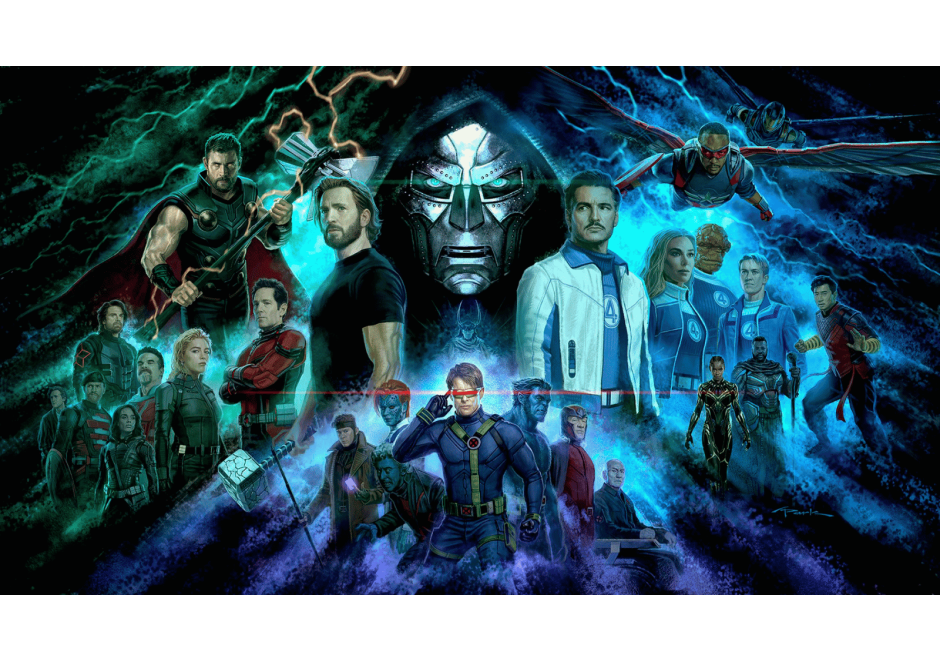
Marvel’s official description of Avengers: Doomsday confirms that heroes from three distinct universes will be placed on a collision course against an existential threat.
This suggests that the movie will bring together multiple generations of Marvel characters.
Some of the major returning characters include:
- The Avengers: Thor, Captain America (Sam Wilson), Ant-Man and other familiar heroes.
- The Fantastic Four: Reed Richards, Sue Storm, Johnny Storm and Ben Grimm.
- The New Avengers: Yelena Belova, Bucky Barnes, Red Guardian and other members.
- The X-Men: Professor X, Magneto and other familiar mutants.
- Loki: His connection to the timelines could become particularly important.
But the biggest question remains: What exactly does Doctor Doom want?
There are several possibilities:
Theory 1: Doom wants to control the multiverse.
He may believe that the only way to prevent universal destruction is to bring every reality under his control.
Theory 2: Franklin Richards is the key.
Doom could be interested in Franklin’s extraordinary abilities and might attempt to use them to achieve something beyond ordinary scientific or magical power.
Theory 3: Doom wants to become the saviour of reality.
Perhaps the most interesting possibility is that Doom does not see himself as a villain. He might genuinely believe that he is the only person capable of saving existence.
This would make him particularly dangerous because he could consider his actions justified, even when they destroy the freedom of others.
All three remain theories until Marvel reveals more of the story.